Case study · UX/Product Design · Site & Backend Architecture
Decorté Website Redesign & Shopify Retheme
A full front-end overhaul and a ground-up Shopify backend restructure, delivered in two months on a live, revenue-generating storefront.
+38.8%
Total sales YoY, first full month post-launch
2.57%
Conversion rate at launch (+44% YoY)
$123.37
Average order value at launch (+35% YoY)
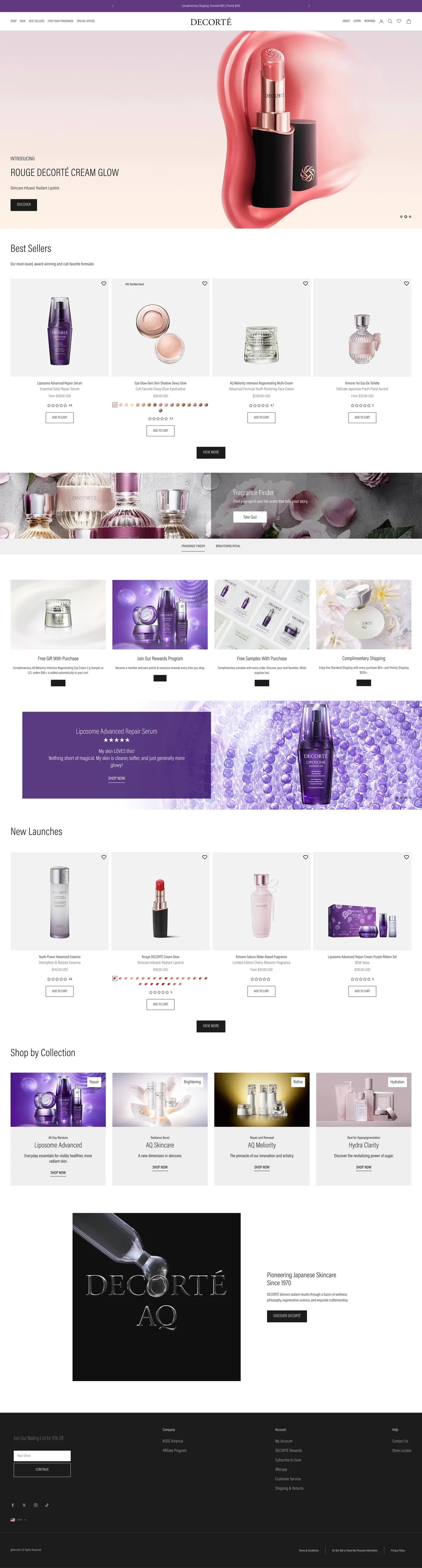
Homepage
Scroll inside each frame to see the full page.
Before — legacy theme

After — redesigned storefront
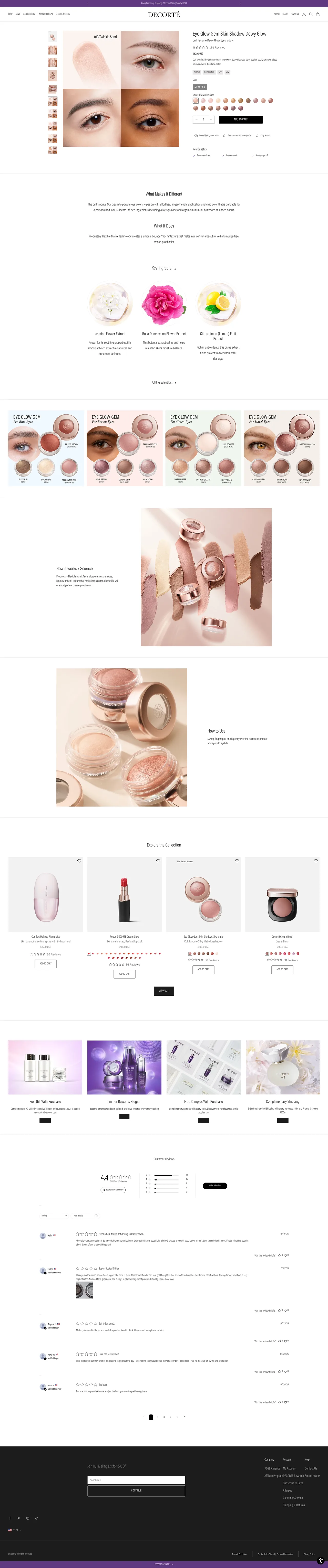
Product detail page
Scroll inside each frame to see the full page.
Before — legacy theme
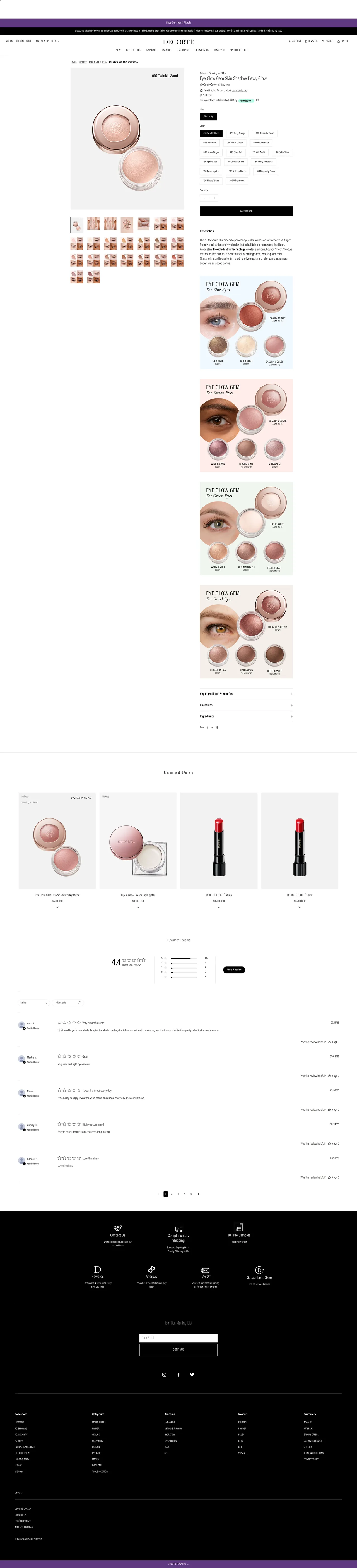
After — redesigned storefront
01
Overview
Decorté, the U.S. e-commerce arm of Japanese luxury skincare house KOSÉ America, engaged Nue24 to redesign and retheme its Shopify Plus storefront. The project ran August–September 2025 and combined a full front-end UX/UI overhaul with a ground-up restructuring of the site's Shopify backend — replacing a legacy, hard-coded theme with a modern, structured content system built on metaobjects and templates.
As UX/Product Designer and site architecture lead, I owned the engagement end to end: auditing the existing site, planning new information architecture, designing the UI in Figma, restructuring the Shopify backend, and partnering directly with developers through a full theme migration. The result was a site that is not only visually refreshed but structurally modern — and the business impact showed up immediately and held for the better part of a year: a 38.8% year-over-year sales increase in the first full month post-launch, a 57% lift when comparing the months immediately before and after relaunch, and sustained double-digit growth across an 11-month trailing window.
02 — The Challenge
Decorté's storefront was running on a significantly outdated version of its Shopify theme.
This wasn't just a cosmetic problem — the age of the theme was actively constraining the business:
01
Integration issues
the outdated theme architecture was incompatible with newer Shopify apps and third-party integrations, limiting which marketing, personalization, and merchandising tools the team could adopt.
02
App installation limitations
several current-generation Shopify apps couldn't be installed or run properly on the legacy theme foundation.
03
A disorganized backend
content and product data weren't structured in any consistent way, making the site harder to audit, update, and hand off between team members.
04
No access to modern Shopify features
the theme predated newer platform capabilities that competitors on current themes could already use.
05
No metaobjects or Shopify templating
the site wasn't using Shopify's structured-content system at all.
06
Hard-coded content
product copy and key product features were written directly into the theme's code rather than stored as editable, structured data. Any content change required a developer and a code edit, even for routine updates.
Taken together, these constraints meant the team couldn't move quickly — every content update, every new app, every seasonal campaign required disproportionate engineering effort. The redesign needed to solve the surface-level UX problems and the underlying architectural ones in the same engagement, or the site would drift back into the same state within a year.
03
Approach & Process
Discovery & Planning
Audited the existing site's information architecture, navigation, and content structure to identify what to keep, what to restructure, and what to cut.
Planned a new site structure and information architecture designed around how customers actually shop a multi-line skincare catalog — by collection, by benefit, and by personalized ritual.
Design
Designed wireframes, user flows, and high-fidelity UI in Figma for the full storefront — homepage, collection pages, product detail pages, and supporting content pages.
Focused on visual hierarchy and shopping experience: clearer merchandising modules, more prominent product discovery entry points (including the site's quiz-based “Find Your Ritual” experiences), and a cleaner path from discovery to cart.
Backend Architecture Restructure
Rebuilt the site's content model around Shopify metaobjects and templates, replacing the prior hard-coded approach.
Migrated product copy and product features out of the theme's code and into structured, admin-editable fields — so future content changes no longer require a developer or a code deploy.
Structured the backend specifically so it could be updated and extended going forward, rather than solving the immediate problem in a way that would age the same way the previous theme did.
Implementation & Collaboration
Collaborated directly with developers and Decorté/KOSÉ stakeholders throughout a full Shopify theme migration, from design handoff through QA and launch.
Coordinated the cutover to minimize disruption to a live, revenue-generating storefront.
04
The Solution
The shipped redesign delivered on two fronts simultaneously — a front-end experience aligned to Decorté's premium positioning, and a backend foundation built for the long term:
Refreshed UX/UI
reflects Decorté's premium Japanese-skincare positioning, with improved visual hierarchy across the homepage, collections, and product pages.
Modernized, maintainable backend
content and product features live in structured metaobjects and templates, so the team can update copy and product information without engineering support.
Improved shopping experience
clearer navigation and merchandising, supporting both direct product search and guided/quiz-based discovery.
Future-proof theme foundation
compatible with current and future Shopify apps and integrations — removing the app-installation and integration constraints that limited the previous site.
Reduced reliance on third-party apps
several functions previously handled by paid third-party apps were replaced with native theme functionality post-retheme, simplifying the tech stack and lowering recurring app costs.
05
Results & Impact
Total sales, conversion rate, and average order value rose in every window measured — at launch, in a same-year before/after comparison, and across nearly a full year of trailing data.
Launch month
Sep 2025 vs. Sep 2024
+38.8%
Total sales
+44%
Conversion
+35%
Order value
Immediate before / after
Sep–Nov 2025 vs. Jun–Aug 2025
+57%
Total sales
+5%
Conversion
+34%
Order value
Sustained, 11 months
Sep 2025–Jul 2026 vs. year prior
+19%
Total sales
+15%
Conversion
+22%
Order value
49.5%
returning customer rate in the launch month, up 75% year over year — the redesign improved repeat purchase, not just first-visit conversion.
84%
of launch-month sessions were mobile, so the mobile experience carried most of the traffic and conversion gains.
06
Reflection
This engagement is a good example of what it looks like to own a project across its full stack — design, backend architecture, and business outcome — as a single point of accountability. The visual redesign is what stakeholders see first, but the more durable win was structural: replacing hard-coded content with a metaobject-based system means Decorté's team can now update product copy, launch new content, and adopt new Shopify apps without waiting on a developer for every change. That foundation is part of why the performance gains held for nearly a year rather than fading after a launch bump.
This project is one of several Decorté engagements delivered through Nue24, alongside the Fragrance Finder quiz (live since March 2025) and the Skin Finder quiz, a custom-built personalization engine (launched August 2026).
All performance figures in this case study are drawn directly from Decorté's Shopify Plus organization-level analytics dashboard (store-specific view, isolated from Decorté Canada), captured Aug 13, 2026. Percentage changes reflect Shopify's own period-over-period comparison calculations for the date ranges shown. Where a metric is described as “sustained” or “held,” that refers specifically to the 11-month trailing window, which runs from the month of relaunch through the most recent complete data available at time of writing.
More work