Decorté · 2026 · UX Design · Product Discovery · Personalization · E-Commerce
Ritual Finder
A guided product-discovery tool that turns a luxury skincare catalogue into a personal ritual.

277,200
Answer-combination scenarios modeled
9
Questions in the quiz
54.8% → <15%
Tie rate, before and after
01
Overview
Decorté, a skincare brand under KOSÉ, needed a way to turn its product catalog into a personalized shopping experience: a quiz that could ask customers about their skin and confidently point them to the right ritual. I designed the UX/UI for that quiz — the “Ritual Finder” — and, separately from the visual design work, took ownership of a harder problem underneath it: turning the client's raw product and business-rules data into recommendation logic that actually worked, then using AI to prove it worked across every possible answer combination before it shipped.
The quiz is live on Decorté's Shopify site. A developer built it; the client supplied the underlying product database. My work sat at the intersection of the two — design, and the structured logic that made the design's promise (a confident, personalized answer) actually true.
02
My Role
UX/UI design
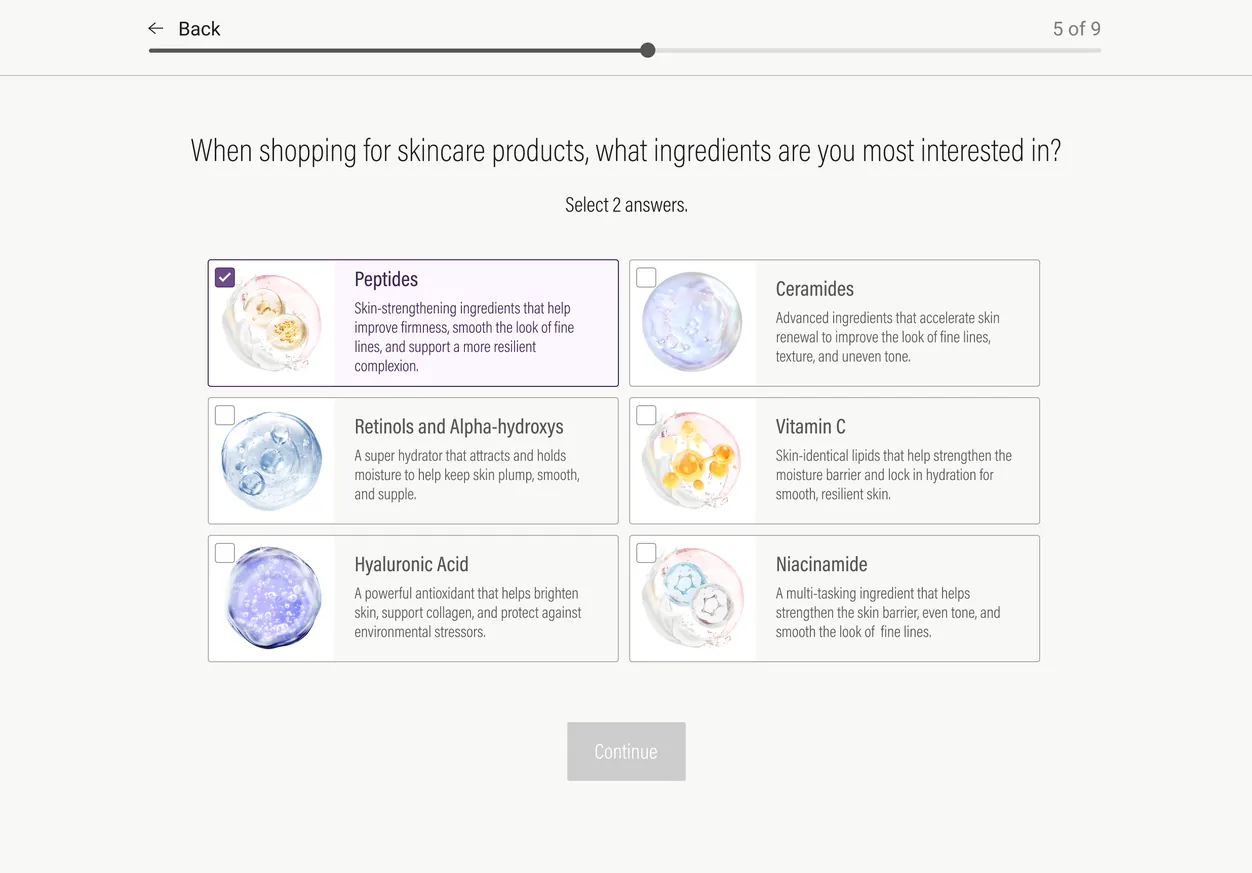
designed the full quiz flow and screens — one question per screen, a supporting illustration per answer (e.g., a face diagram per skin type), optional “why we ask this” info tap-outs, and short storytelling copy explaining the reasoning behind each question.
Logic design & data architecture
organized the client's raw product/business-rules spreadsheet into structured logic sheets — question-by-question rules, product-to-concern mappings, ritual-step sequencing, and tie-breaking rules a developer could actually build from.
AI-assisted scenario modeling
used Claude to programmatically enumerate every possible outcome the quiz could produce across every combination of answers, so the full scenario space could be checked for gaps, conflicts, and tied results — impractical to check by hand at this scale.
Cross-functional facilitation
ran an ongoing loop between the client (brand priorities), the developer (technical feasibility), and myself (UX + logic) — presenting AI-modeled findings, proposing rule changes to resolve conflicts, and handing off validated logic for implementation.
03
What the Quiz Does
A 9-question quiz recommends a personalized AM/PM skincare ritual — specific products for each step — based on:
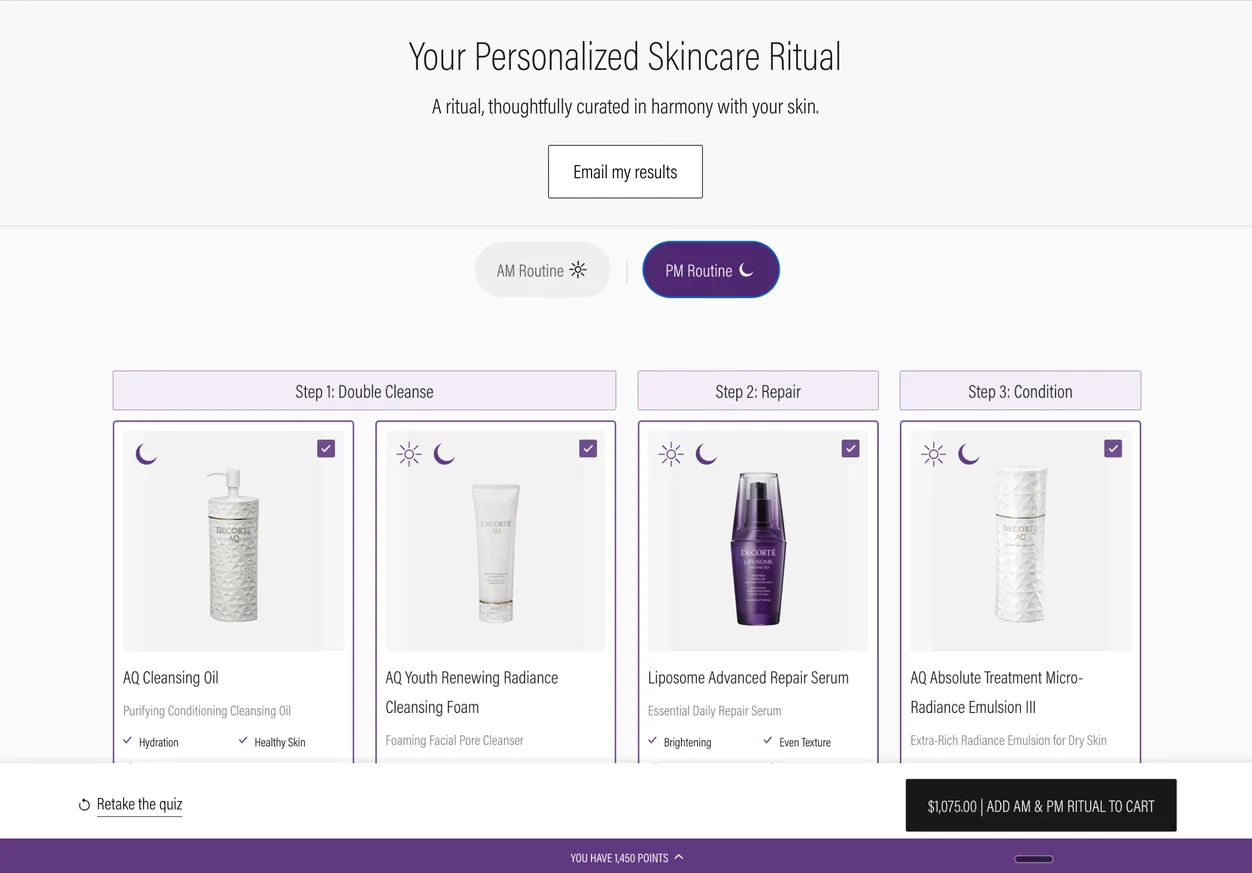
Answers map to 5 core product lines (Liposome, AQ, AQ Brightening, AQ Absolute Treatment, AQ Meliority) and resolve into a 4-step or 6-step AM/PM ritual, with a specific SKU assigned to each step: cleanse, repair, lotion/emulsion “essence” layering, moisturize, and eye care.

Skin type
4 options (Normal, Dry, Oily, Combination)
Top skincare concerns
user's top 3 from 10–12 options (fine lines, dryness, dullness, hyperpigmentation, enlarged pores, sagging, thinning skin, dark circles, puffiness, and more)
Age range
5 brackets (18–24 through 55+)
How skin feels throughout the day
4 options
Ingredient preference
6 options (peptides, retinols/AHAs, hyaluronic acid, vitamin C, niacinamide, ceramides)
Familiarity with Japanese lotion/emulsion layering
4 options
Lifestyle impact on skin
4 options
Current routine complexity
moderate (2–4 products) or advanced (6+ products)
SPF usage frequency
4 options
04
The Scale of the Logic
Before this could ship as a confident, single-answer recommendation, the underlying logic had to hold up across every combination of the 9 questions — a much larger problem than it first appears:
No one was going to manually trace 277,200 scenarios by hand. That gap is what the AI-modeling work was for.
277,200
distinct answer-combination scenarios in total
120
possible combinations from the “top 3 concerns” question alone (3 chosen from a pool of 10 eligible concerns)
3 tiers, 5+ lines
each scenario resolves to a specific product recommendation per ritual step, across 3 product tiers and 5+ product lines
05
The Problem We Solved: Tie Rates
The client's raw data translated into logic that, in its first working version, produced a high rate of “ties” — scenarios where two or more products scored equally for the same ritual step, so the quiz couldn't confidently recommend just one product. I used AI to calculate exactly how often this happened, broken out by which ritual step was affected. This was the starting point:
From that baseline, I worked with the developer and client through four rounds of logic revisions — an elimination rule for out-of-range products, concern-based moisturizer bonus scoring, a fix for an AM/PM sequencing bug, and concern-line “hard gates” to resolve remaining ties — bringing every individual ritual step's tie rate down to under 15%.
Results
Every ritual step below a 15% tie rate
Baseline v4 tie rate against the final v7 rate, per ritual step. After four rounds, every individual step finished under 15%.
06
Process
01
Received the client's raw product/business database: a multi-tab spreadsheet of SKUs, pricing, per-question product eligibility, and hand-written business rules in prose.
02
Organized it into clean, structured logic: question-by-question answer options, product-to-concern-and-age eligibility, ritual-slot assignment rules, and tie-breaking rules.
03
Used Claude to expand that logic into all 277,200 possible scenarios and flag which produced ties, duplicates, or gaps (e.g., a PM-restricted product suddenly being recommended for PM).
04
Reviewed flagged issues with the developer to separate logic bugs from genuine ties that needed a business decision.
05
Brought genuine ties back to the client with specific proposed rules (“hard gates”) that matched brand priorities — e.g., prioritizing the product line tied to a user's stated top concern.
06
Iterated across at least four logic versions (v4–v7), each with a documented changelog and before/after impact numbers.
07
Designed and handed off the UX/UI for the quiz screens: question flow, illustrations, info tap-outs, storytelling copy, and results presentation.

07
Tools & Collaboration
Claude (AI)
organizing and validating logic, and enumerating the full scenario space for tie-rate analysis
Excel / Google Sheets
structuring the client's raw data into buildable logic documentation
Figma
UX/UI design of the quiz screens
Team
a developer for implementation, and the Decorté/KOSÉ team for business rules and approval
08
Skills This Project Demonstrates
01
UX/UI design for a multi-step, branching quiz experience
02
Translating messy, real-world client data into structured, buildable logic
03
Using AI as a QA and modeling tool to catch issues at a scale (277,200 scenarios) manual review can't cover
04
Data-driven iteration: quantifying a problem, proposing a fix, and measuring before/after impact
05
Cross-functional facilitation between a client, a developer, and design/logic ownership
09
Try the flow
A simplified click-through of the question pattern — one question per screen, with the reasoning available on tap. Product mapping here is illustrative, not the shipped logic.
Moderate routine — 4 steps

Advanced routine — 6 steps

More work